Costa Rica Expat Tours

find your new life in paradise

  • Home
  • Expat in C.R.
    • Costa Rica Expat Haven
    • The 4 C’s Framework
    • Take the Tour Before You Buy!
  • Our Tours
    • Costa Rica Expat Consulting
    • Exploratory Rental Search
    • Book Your Tour
    • Testimonials
  • Blog & Podcast
    • Blog Archive
    • World Changers Expat Podcast
    • The Definitive Guide -2nd Edition
  • About
    • Costa Rica Expat Properties
    • Costa Rica Commercial Real Estate

Archives for September 2019

The Allure of the Costa Rica Southern Zone

September 29, 2019 by Costa Rica Guy 3 Comments

The Allure of the Costa Rica Southern Zone

The allure of the Costa Rica southern zone that attracted me almost nine years ago was that it possessed both of the things that I love most about the country in general, i.e., its mountains and beaches.

I found out later that the people are pretty special here too!

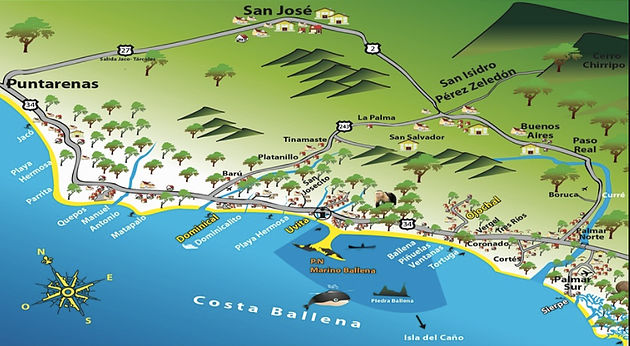
Now, when I say “southern zone”, I am primarily talking about the mountainous area called Perez Zeledon and the coastal area called the Costa Ballena. Granted, there’s more to the southern zone that that, but this post will focus on those two areas that tend to draw the most people.

To begin, what is it about the Costa Ballena, versus other coastal areas of Costa Rica, that makes it so special? I like to keep things simple, so I’m going to break down the Costa Ballena to its component parts of Dominical, Uvita and Ojochal, and then focus on the “one thing” that makes each part special.

Dominical is a stretch of coastline that is very open to Pacific swells. Back in “the day” the road between Quepos (or Manuel Antonio) and Dominical was unpaved. Only the most adventurous would make that arduous trek, which could take up to 2 hours, versus the half-hour it takes today traveling along the Costanera Highway, what I like to call Costa Rica’s Autobahn. The only real draw back then was the surf. Dominical has some of the most consistent (and at times very powerful) waves of the country. The village grew up into a highly regarded tourist destination wholly on the reputation of it being a surfer’s paradise.

So, it’s the great waves that make Dominical stand out, pure and simple.

Folks that live along the Costa Ballena usually refer to “going into town” as going to Uvita. Uvita is the most active and developed of the three beaches of the Costa Ballena. It is also home to a very famous and popular national park, the Marino Ballena National Park. Uvita has an area we realtors like to call “the flats”, that extends from town (which has developed largely along the Costanera Highway) to the ocean. Moving away from the coastline and just beyond the so-called flats is the Fila Costeña mountain range. Many of the high-dollar homes and resorts built in this area are up in those hills. From there you have a dramatic view of what draws thousands to the area each year, the Whale’s Tail. This is basically a rocky sandbar formation that is shaped just like, you go it, a whale’s tail. That’s very ironic since the marine area off the coast is home to a very important migratory route for humpback whales.

So, what tends to draw people to Uvita are the spectacular views of its famous Whale’s Tail (and, of course, the whales themselves).

As you pass Uvita driving south along the Costanera you will arrive at the final Costa Ballena component known as Ojochal. Tourists in the area have a horrible time remembering and/or pronouncing the name. The pronunciation is easy if you just remember that the “j” sounds like an “h” and the two “o’s” both have the long vowel sound, with the “a” being short, so o-ho-chal.

Now, back before the road was paved, Ojochal was completely off the map for gringos. It really isn’t a place for surfing, so even the most adventurous surfers didn’t pay any attention to it. Boy has that changed. I would venture to say that Ojochal is currently the fastest growing of the the three Costa Ballena beaches. It is also the home to a thriving and close-knit community of North American expats from the U.S. and Canada. A few of them have started restaurants, which has helped Ojochal gain the reputation of being a culinary hotspot. It is also the area where an expat can find a home with ocean view at an affordable price, as those in the areas of Dominical and Uvita tend to be out of budget range for many.

So, what draws people to Ojochal is community, meaning an expat community where there’s always some sort of socializing going on.

If you read this blog from time to time you probably know that I opted for the mountains of Perez Zeledon rather than the beach. You also might have read about my four C’s of Costa Rica expat living (Climate, Convenience, Culture and Context). In my humble opinion and according to my tastes, the mountains beat the beaches on the first three of my four C’s. The last one (context) is entirely subjective. However, if I had to break it down to the thing or things that are the biggest draws for Perez, I’d have to say it’s actually the “three C’s” noted below…

The number one reason any Perez Zeledon expat will mention if you ask them why they live in the mountains versus the beach is climate. There’s a world of difference in temperature between, say, 900 meters (the altitude where I live) and sea level. San Isidro has been called the fastest growing city of Costa Rica. You can live a ways outside of it (in the cool mountains) and still have its many conveniences at your fingertips. I live in the mountains outside of town at 900 meters, but it only takes me 5 minutes to get downtown and often I even walk it! Finally, there is no arguing that you can make ends meet in Perez a whole lot cheaper than at the beach. Perez is a tico-dominated culture, whereas the beach is tourism-dominated. And ticos on the whole simply can’t afford to pay tourism prices. Many of us gringo expats don’t like to pay tourism prices either!

So, what draws expats away from the beach and to Perez Zeledon are the three C’s of climate, convenience and cost.

Of course, it’s all subjective, according to individual tastes, and everything about the allure of the Costa Rica southern zone written above is purely the opinion of a lone gringo who’s lived in the area long enough to sort of have a handle on what makes it tick.

Deciding on the particular allure of the Costa Rica southern zone that floats your boat is certainly the most important thing (for you). I hope this post helps you get your own unique handle on that.
Don’t miss The Allure of the Southern Zone – Part 2

Filed Under: Costa Rica Expat Living Tagged With: Allure of the Costa Rica Southern Zone

Earning Income as a Costa Rica Expat

September 22, 2019 by Costa Rica Guy 5 Comments

Earning Income as a Costa Rica Expat

Some expats in Costa Rica arrive without ever needing to work another day in their lives. How fortunate for them! Others, like me, have to work for a living.

This post explains the ins and outs of earning income as a Costa Rica expat.

Legal Implications

I was only being half facetious with the “legal” qualifier. Some expats – not you or me, of course – come to Costa Rica with the idea of exploiting the local population for nefarious causes, or they get involved in questionable pursuits. Some of them are shown the door by Costa Rican immigration authorities. Others end up in a Costa Rican carcel (Spanish for jail). Please don’t be one of those!

What can you do legally for earning income as a Costa Rica expat? Well, for starters, if you aren’t yet a resident, or even if you have achieved “temporary residency status”, you can’t be an employee of your own company, or anyone else’s. You can, however, start, own, and operate a business as a manager/owner. You can draw income in the form of cash distributions, or even loans, from that business.

Lifestyle Income Producing Options

One thing many expats get into, including yours truly, is real estate. Now, granted, I’m a permanent resident. So, I could work and draw a salary in Costa Rica as an employee with all the worker’s rights afforded a Costa Rican citizen. I’ve never done that and don’t plan to. But, even if I wasn’t a permanent resident, I could still work as a real estate agent under the roof of a local real estate brokerage. In my case, that’s Coldwell Banker in Dominical. I am essentially operating my own business as an agent. And you can do the same. Many do and do so without ever receiving any form of Costa Rican residency.

There is a wrinkle that has only recently come to the fore for non-resident agents, i.e., perpetual tourists operating as real estate agents. The government agency that regulates banking (SUGEF), especially as it relates to potential money-laundering, is now requiring all agents to register. In order to do that you have to get what’s called a digital signature. In order to get that you have to be a resident. Many agents are getting around the requirement by registering through corporations. But that is more difficult and I wouldn’t be surprised to see the SUGEF close that loophole in the future, effectively making it impossible to legally work as a real estate agent as a non-resident.

Real estate is just one lifestyle business option one might choose for earning income as a Costa Rica expat. Many also operate online businesses as writers, consultants. tourism agents, sellers of various products, etc., etc. These days offering your expertise, or some unique product, online is a great option. You’ve got the whole world as your market.

Renting property, either in the form of long-term rentals, or vacation rentals, is a great idea. You could convert your property to a B&B. You could simply rent out a separate room, or studio apartment, on Air B&B, Home Away, VRBO, or others. You could buy and operate a small boutique hotel.

Many get involved in offering some kind of unique tourism experience to vacationers. Others get involved in producing arts and crafts, or organic products, and sell them to other expats. The list of ideas in virtually endless.

The bottom line is that with a good internet connection and access to the world wide web, the ideas for earning income as a Costa Rica expat are as wide-open as your imagination.

Hiring Employees

Even though as a non-resident, or even as a temporary resident, you can’t work for your own company as an employee, you can still hire others. Costa Ricans can make great employees, sometimes. If you plan on hiring employees in Costa Rica you need to know what you’re getting into. Costa Rica has very strict pro-worker laws that govern employment relationships. Hard-core capitalists would probably call them socialistic.

Employment taxes are extremely high compared to the U.S. Employers must kick in around 26% of wages, with the employee having to pay an additional 9%. The employer is responsible for collecting and remitting these taxes to the CAJA, or Costa Rica social security administration.

Employees are guaranteed a full month’s wage bonus at the end of the year, called the aguinaldo. That must be paid regardless of your business’s ability to pay it. It is also hard to fire an employee and when you do you have to pay them a guaranteed severance plus any unpaid vacation for every year they worked.

I have paid out $1,000’s for these items to employees over the years. It is probably better to steer clear of hiring employees in Costa Rica to the extent that is feasible for your business. And if you do hire, make sure to dot your i’s, cross your t’s, and get a good lawyer to advise you.

Getting Paid

Getting paid from customers buying your goods or services from afar is incredibly easy these days. You can use an online payment processor like PayPal, Square, or many others. You can link your PayPal account to a Costa Rican bank, or it can be linked to a U.S. bank. In the latter case, you can use wire transfers, or ATM withdrawals and credits cards, or a combination of both, to access the funds in Costa Rica.

You can also set up a merchant service account with a Costa Rican bank. It is important to have a corporate Costa Rican account for such purposes, rather than a personal checking or savings account. For instances, a personal account linked to PayPal will only allow you to transfer $1,000 per month from your PayPal balance, whereas for a corporate account that limit goes up to $10,000.

The Tax Man Cometh

Costa Rica will not impose any taxes at all on companies registered in the country, or individual residents of the country, that do not actually generate revenue within Costa Rica. That is far different from the U.S., which taxes the worldwide income of any U.S. citizen, or U.S. corporation.

As noted above, the U.S. has a worldwide income taxation regime. Meaning that the U.S. taxes your income, no matter where it’s generated. So, if you come to Costa Rica and establish some sort of business that generates an income in Costa Rica, you are required to report it on a U.S. income tax return.

However, you could qualify for what is known as the Foreign Earned Income Exclusion. This allows you to exclude from your U.S. income, foreign earned income of around $100,000 per taxpayer (so, $200,000 for marrieds filing jointly). The exact amount of the exclusion is adjusted each year for inflation.

To qualify for the exclusion you either have to have lived in the foreign country for at least 330 days out of any period of 12 consecutive months, or have lived in the foreign country for an entire tax year.

The exclusion is complicated and the ins and outs of its application are beyond the scope of this post. For more complete information, you should obviously consult a tax professional.

As an expat you can have bank accounts in local and/or U.S. currency. There are reporting requirements for foreign owned bank accounts. One is the FBAR (Foreign Bank Account Report), which is required if you have $10,000 or more in your foreign bank account at any point during the U.S. tax year. Also, there is the FATCA (Foreign Account Tax Compliance Act), by which foreign financial institutions are required to report on the accounts of their American clients as part of the U.S. initiative to uncover tax cheats. If you have specified foreign financial assets that exceed certain thresholds, you are required to file Form 8938 (which you would send with your regular tax return to the IRS).

Costa Rica passed a law not too long ago that requires certain accounts, especially those owned by foreigners, to be verified periodically. They call it the requirement to “actualizar datos.” It simply means you have to show them where the money is being generated. The law was enacted to prevent money laundering. It’s not that onerous a requirement, but it can slip up on you. If you fail to do it, you might find your account frozen until you do. The bank is supposed to notify you and give you time to do it, but I’ve had my account frozen without them ever telling me a thing.

How I’ve Made a Living in Costa Rica

I’ve operated a tourism business in Costa Rica since 2003. I now also work as a real estate agent with Coldwell Banker in Dominical. I’ve done other things as well for earning income as a Costa Rica expat. I once owned a small shop in San Jose where I sold 100% indigenous arts and crafts that I acquired on a “fair trade” basis directly from the 6 tribes of Costa Rica. I also sold the arts and crafts online via a web site. So, I’ve done quite a few things to make a living during my almost two decades of expat experience.

With the exception of the real estate income that I generate these days, income that I have earned has always been generated abroad. Virtually 100% of my sales were online and most of the time customers where either in the U.S., or Canada. For years I used a merchant service account in the U.S., as well as PayPal, to accept payments.

I transferred the money to Costa Rica primarily with international bank wires, or I would simply use my PayPal debit card to get money from ATMs in Costa Rica, or make payments with the card. Constantly moving money from the U.S. to Costa Rica can get expensive. It will definitely take a bite out of your profits. Back when I started there weren’t really good options for Costa Rican based merchant service accounts. Now there are. Also, back then there was no way to link a PayPal account with a Costa Rican bank account. Now there is. So, bottom line is that these days it’s much easier to operate your business and get paid than it was when I first started.

It pays to think all these issues through with respect to your ideas for earning income as a Costa Rica expat. How will you get paid? How will you access the money in Costa Rica in the cheapest manner possible?

And most importantly, how will you go about earning income as a Costa Rica expat while still truly enjoying the life that you envisioned having here?

It’s best to take a clue from the ticos, who work in order to live, as opposed to the common gringo mentality of living in order to work.

Filed Under: Costa Rica Expat Living Tagged With: earning income as a Costa Rica expat

The Costa Ballena – Costa Rica’s Big Sur

September 15, 2019 by Costa Rica Guy 1 Comment

The Costa Ballena

I write a lot about the Costa Rica mountains in Perez Zeledon, where I live. It is the only place in Costa Rica where you can live in seriously high mountains (highest in Costa Rica, actually) and still be so close (less than an hour) from the beach.

Nevertheless, I don’t want to create the impression that the beach, in and of itself, is not great too!

I have referred over the years to our coastline here in the southern Pacific, the so-called “Costa Ballena”, as the Big Sur of Costa Rica…

Why?

Ok, let me explain the topography of the area a bit. If you take the Pan American highway from San Jose up over the Cerro de la Muerte and then down into the valley where San Isidro de El General is located, you are essentially driving over the tallest range in the country, the Talamancas. Chief among the peaks is Cerro Chirripo, Costa Rica’s highest at 3,821 meters (12,536 feet). Chirripo casts its tall shadow over the entire valley, which spans the distance between the Talamancas and the smaller coastal range, which we usually refer to as the Fila Costeña (also, Fila Brunqueña, after the Brunca indigenous peoples that have long made a home in the coastal range).

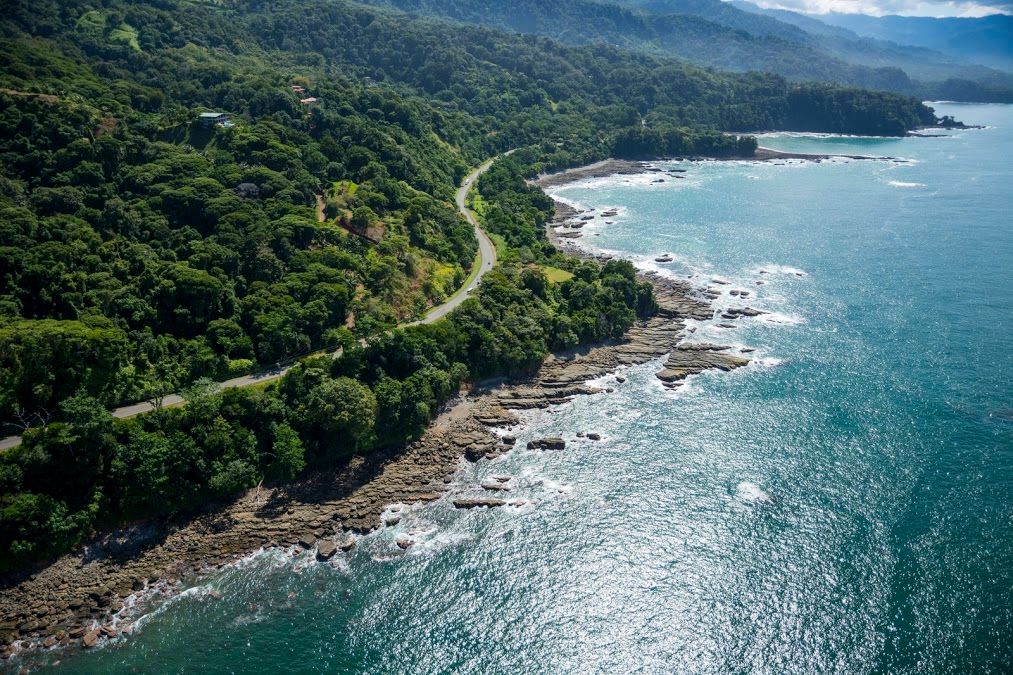
The Fila Costeña hugs the coastline and offers scenic and rocky ocean vistas that rival the Big Sur of California. I’m sure some might take issue with the comparison, but nevertheless it get’s the point across.

The Costa Ballena consists of numerous small communities that line the coastal highway, or Costanera. Chief among them are the popular tourist areas of Dominical, Uvita and Ojochal, with Dominical being the most northern of the three and Ojochal the most southern. However, each is only about 15 minutes from the other and the highway that links them is one of the best in Costa Rica, so it is very easy to travel around in the area and experience all of it.

There are a number of reasons this area is really very special…

First, there are the waves. The perennially popular “surfer dude” town of Dominical boasts some of the most consistent breaks in the country. However, there are numerous other surfing spots that dot the coastline as well, with waves that range in class from only for the experienced to perfect for beginners.

Then there’s the flora and fauna. Quite a bit of area is covered by the Costa Ballena. Unlike our neighbor to the north, Quepos and the popular tourist destination of Manuel Antonio, there is virtually no high-density condo-type development along the Costa Ballena. For one the topography of the area doesn’t really lend itself to that and second, the government has been quite guarded against any development that would threaten one of Costa Rica’s last largely undeveloped stretches of jungle-covered coastline.

So, the mountains that hug the coast are carpeted with a lush and green rainforest that is absolutely teeming to the brim with flora and fauna. Just to the south of us is the famed Osa Peninsula and the Corcovado National Park, which National Geographic once dubbed the most biodiverse location on the planet.

Despite the claim of the area being largely undeveloped that I just made above, there are nevertheless a lot of attractions that are making the Costa Ballena one of the fastest growing tourist locations, as well as a favorite retirement haven for expats…

The tourist options in the area are varied. I already mentioned the great waves. We also are blessed with the Marina Ballena National Park, which is a vast stretch of beach and marine park area that contains an important migratory route for the humpback whale. During the prime whale-watching months of August, September and October, many tourists come to the area to get a glimpse (and possible a splash) of these magnificent creatures.

The adventure-loving expats that one can find in our area love it primarily because it has not undergone the dense development of other areas, like Manuel Antonio, Tamarindo, or Jaco. Many have bought or built homes up in the hills with incredible ocean views, cool breezes and surrounded by their own private jungles. Many have opened cool and hip businesses that help make the bar and restaurant scene a very active and fun one.

The Costa Ballena is also home to the annual Envision Festival, which occurs in February of each year. It is Costa Rica’s version of “Burning Man” and it attracts thousands who are looking for the unique spiritual experience it offers.

Of course, my favorite thing about the area is that I can live up in my blessed mountains and still be close enough that a day-trip to the beach is an ever-possible spur of the moment decision at my disposal. You just can’t say that about any other area of Costa Rica.

And the city of San Isidro de El General, which lies less than an hour from the coast, is one of the fastest growing in Costa Rica and likewise offers the beach dwellers a great option for shopping, medical services, and entertainment choices that seem to grow a bit day by day.

You just have options in our area that other parts of Costa Rica can’t provide…

You can be like me and live in the mountains and visit the beach any time you want. Or you can live at the beach and visit the mountains any time you want.

In my opinion, for the Costa Rica expat who really wants to experience what “the real” Costa Rica is all about, it just doesn’t get any better than that!

Filed Under: Costa Rica Expat Living Tagged With: Big Sur of Costa Rica, The Costa Ballena

The Costa Rica Real Estate Purchase Process

September 8, 2019 by Costa Rica Guy 4 Comments

Costa Rica Real Estate Purchase Process

The Costa Rica Real Estate Purchase Process – In 4 “Easy” Steps…

I get questioned often about how the Costa Rica real estate purchase process compares with that of the U.S., or Canada.

The truth is it differs quite a bit…

Step One – The Offer

You make your offer very informally, usually via what we call a “letter of intent.” Back in the states we used letters of intent for mergers and acquisitions type deals, but for real estate sales, offers were made via approved forms that all realtors used and would just fill in the blanks. Here in Costa Rica there is no “approved” form. The letter of intent, or LOI, is usually drafted by the realtor. They differ in content and style from agency to agency. The purpose of it is basically to hold the deal in place, so to speak, until an attorney-drafted real estate sales and purchase contract is prepared.

Key components of the LOI are of course the price and terms of purchase, the amount of earnest money deposit (usually 10% of the purchase price), the time period for due diligence and closing, and and other special terms that need to ultimately make their way into the contract, or SPA. Once the SPA has been drafted and signed by all the parties, the significance of the LOI passes into history.

Does the LOI effectively take the property off the market? It should and most of them are drafted to say such. But many realtors will continue to market and show listings under an LOI up and until the SPA is signed.

Is the LOI binding and enforceable? Not really, in so far as a suit for “specific performance” is concerned. So, in that respect, it is more like a written-down handshake agreement that will be succeeded by an enforceable contract, usually very quickly. There is no earnest money put down by the buyer as a result of the LOI. That doesn’t come into play until the contract is signed (see below).

Step Two – Contract & Escrow

The LOI starts the time clock running to get the deal to an attorney who will draft the contract, or what we call the “SPA” (for sales and purchase agreement). Usually an SPA can be drafted and ready for execution within a week of signing the LOI. The SPA is certainly enforceable, although the effort, cost, and time involved in actually enforcing one through Costa Rica courts is a topic for another discussion.

The SPA will be much more detailed than the LOI, concerning purchase terms, representations of the parties, responsibilities of the parties during due diligence, consequences of default, etc. It is customary for the buyer’s attorney to draft the SPA, unless there will be seller-financing involved. In the latter case, the seller’s attorney usually drafts it. Costs of drafting are normally split 50/50 between buyer and seller.

If the parties to the deal are English speakers, the SPA will be drafted in English. It is never recorded, so there is usually no need for a Spanish translation, unless one of the parties to the deal specifically requires it.

The execution of the SPA begins two important time clocks. One is for the buyer to set up an escrow account. Almost all deals are done through escrow in Costa Rica. This is necessary both for security of the parties, as well as compliance with Costa Rican banking laws. It is virtually impossible for real estate transactions, involving large sums of money coming into the country from outside, to be conducted without escrow. The buyer is usually given a week, or two, to establish escrow. Setting up escrow is a bit of a pain in the ass for buyers, as they have to produce detailed documentation showing the origin of the funds. You basically have to prove you’re not a money-launderer.

Once the escrow is set up and ready to receive funds, the buyer will wire the earnest money deposit into it. The earnest money deposit (usually 10% of the purchase price) is refundable to the buyer up and until the due diligence process is completed satisfactorily (see below).

And that is the other time clock that starts ticking at the time of execution of the SPA, the 30 – 45 day (or longer, as the parties may agree) time period for the buyer to complete due diligence.

Step Three – Due Diligence

The due diligence period begins at the time of signing the SPA and is customarily around 45 days, but can be shorter or longer, as the parties might agree. Items that are usually important for the buyer to investigate are: the construction integrity of the home via a home inspection; a re-measurement of the property’s borders by a licensed surveyor; and a thorough examination of the title record by the buyer’s attorney.

The buyer can back out of the deal at any time during due diligence, for any reason whatsoever. Once the due diligence period is complete the buyer will be asked to sign off and approve that he or she is ready to go forward to closing. At that point, the earnest money “goes hard,” and is non-refundable.

What happens if problems are uncovered during due diligence? These have to be presented to the seller and usually additional time will be given for the seller to remedy them, as necessary. Of course, the seller can refuse and then the buyer has to decide whether he or she will waive the objection and proceed anyway. Another way to settle these matters is with some sort of price concession.

Step Four – Closing

The SPA will also specify the length of time for closing once due diligence is completed. Customarily, this is a period of around 2 weeks. During this time the buyer will need to send the balance of the funds to escrow. It can take up to a week for these funds to reach the account and be credited and ready for closing. I’ve seen closings delayed more for the fact of money not being available than for any other reason.

The closing attorney (usually the buyer’s attorney) will prepare the deed, which in Costa Rica is called the “escritura de traspaso”, or simply the escritura. This document will be in Spanish, as it has to be recorded in the National Registry for the deal to be effective to transfer the property from seller to buyer. Unlike deeds in the U.S., the escritura is very long and detailed and the most time consuming part of the closing ceremony is when the attorney “verbally” translates the escritura into English.

What are the typical closing costs? There’s about 4% of the deal amount that I like to call “pure closing costs.” These include the transfer tax, stamp fees, and the notary fee (which is basically how the closing attorney gets paid). This 4% is customarily split 50/50 between buyer and seller. The SPA will of course specify this split and it is a completely negotiable item. With the new capital gains tax that sellers are starting to get hit with, realtors are suggesting more often that the buyer pay 100% of closing costs. It addition to the pure closing costs, the buyer will also pay for his or her due diligence costs, which can add up to another half a percent to the buyer’s side of the closing statement.

Unlike the myriad of documents one normally has to sign when closing a real estate deal in the States, in Costa Rica essentially there are only two: the escritura and the proceeds disbursal agreement that will instruct the escrow exactly how to disburse the funds at closing.

Of course there are some “details” I am leaving out and there can be (and indeed often are) wrinkles in the Costa Rica real estate purchase process laid out above in simplistic terms.

However, in a nutshell, the above is basically how the Costa Rica real estate purchase process shakes out in a typical deal.

Filed Under: Costa Rica Expat Living Tagged With: Costa Rica Real Estate Purchase Process

Connect with Costa Rica Expat Tours

  • Facebook
  • Flickr
  • Instagram
  • LinkedIn
  • Pinterest
  • Home
  • Expat in C.R.
  • Our Tours
  • Blog & Podcast
  • About

Copyright © 2026 · Parallax Pro Theme on Genesis Framework · WordPress · Log in